
The following regulations apply to vessels sailing on the high seas and in internal seaways.
Power-driven vessels (boats) are all those which are moved by mechanical propulsion.
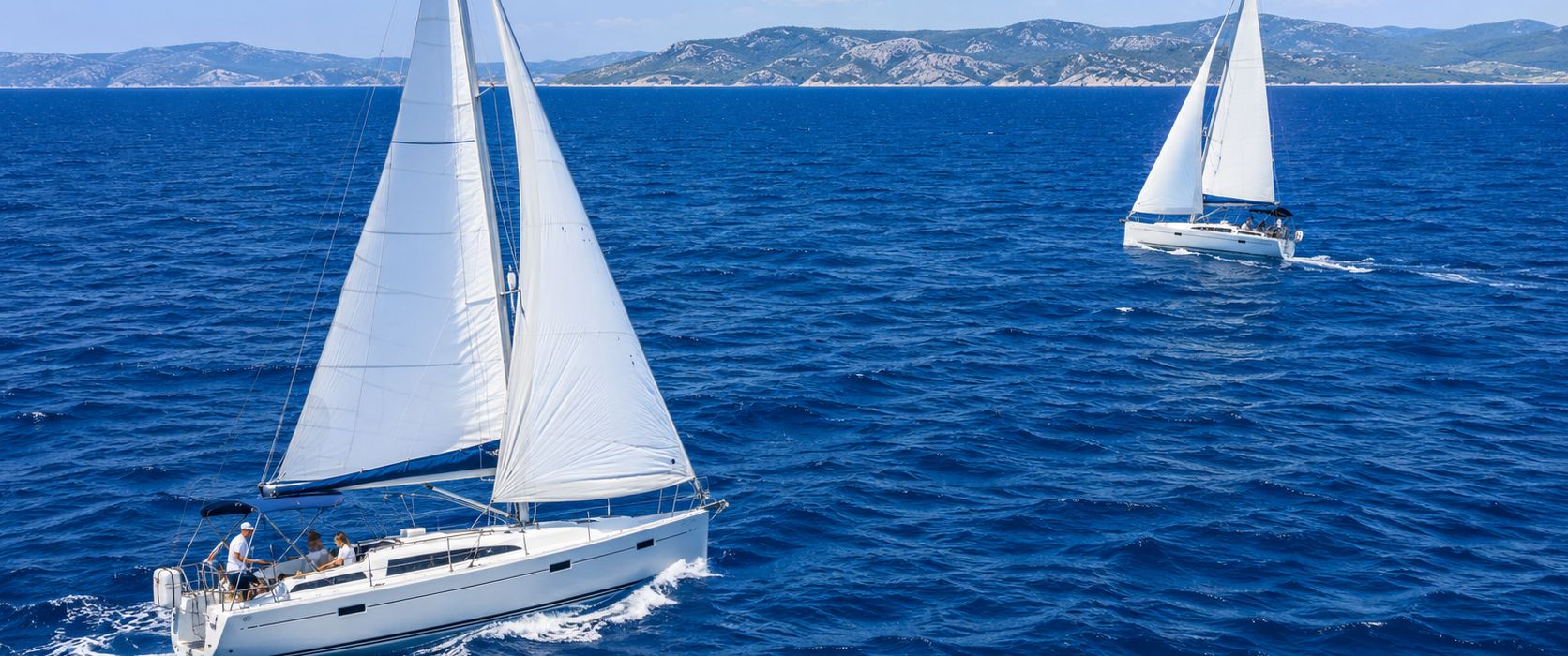
Sailing-vessels are all those which can move by use of sail.
A vessel is considered to be under way if it is not anchored, moored or beached. When sailing at night vessels must show port, starboard, mast and stern lights.
Vessels are considered to have limited manoeuvrability when they are: engaged in work on underwater cables or pipes or with navigation buoys (marks); engaged in dredging or underwater work; loading or unloading persons, cargo or fuel; mine layers at work; tugs or boats towing and unable to manoeuvre to avoid collision.
Ship lights
Navigation lights must be alight from sunset to sunrise, and by day in conditions of poor visibility. Marks need only be shown by day.
White mast light must be visible in sector 112.5° port and starboard of the bows. In vessels 20 m and more the light must be 6 m above the hull. If the vessel is more than 6 m wide, her height is greater than her width but not more than 12 m. In vessels 1220 m in length their height above the bulwarks must not be less than 2.5 m. In vessels less than 12 m the mast light must be at least 1 m above the side lights.
Port and starboard lights must be visible from the bows in the same way as the mast light: green to starboard (right) and red to port (left). On vessels 20 m and more the side lights must not be forward of the front mast light. Combined green-red lights on vessels shorter than 20 m must be at least 1 m below the mast light.
White stern light must be visible at stern sector 135° (67.5° on each side).
Vessel towing another vessel shows a yellow light with the same characteristics as the stern light. The yellow light is positioned vertically above the stern light.
Light visibility
Vessels 50 m and more: white mast 6 M; side lights, stern light and towing light 3 M.
Vessel 1250 m: mast 5 M (vessels less than 20 m 3 M), side lights, stern light and towing light 2 M.
Vessel (boat) less than 12 m: mast light, stern light and towing lights 2 M, side lights 1 M.
Coloured lights (red, green, yellow) that give light to the whole horizon 2 M.
Boats less than 7 m do not need to have navigation lights but must be prepared to show their position at night at least temporarily by showing a white light.
Rules for avoiding collision of power-driven vessels
When two power-driven vessels approach each other from opposite directions and a collision seems possible each should veer to starboard (right).
When the courses of two power-driven vessels cross and collision seems possible the vessel that can see the other to starboard (right) must change the course, but must not cross the bows of the other vessel.
When a power-driven vessel seems on collision course with a sailing-boat the power-driven vessel must give way.
A vessel about to overtake from astern must pass the vessel on the most suitable side.
Rules for avoiding collision of sailing-vessels
When two sail-driven vessels seem on collision course:
- the vessel with wind from port (left) must change course;
- if both vessels are running before the wind then the vessel on the leeward side must give way;
- if the vessel to windward cannot judge the situation with certainty then she must give way to the vessel on the leeward side;
- n some navigation situations vessels must give sound signals (see Sound signalling).
Avoiding Collision in Ports and in Internal Sea Waters
Small vessels (boats) give way to larger vessels. Vessels (boats) entering port, river or narrow channel must not hinder vessels coming out.
The vessel that has advantage in manoeuvring must warn with 5 short and quick signals the other craft that are not following the rules.
Fishing-boats are not allowed to fish in ports by means of lights and in places difficult for sailing, they may use only shaded lights. If they are not following the rules they have to switch off the lights when warned by other vessels.