
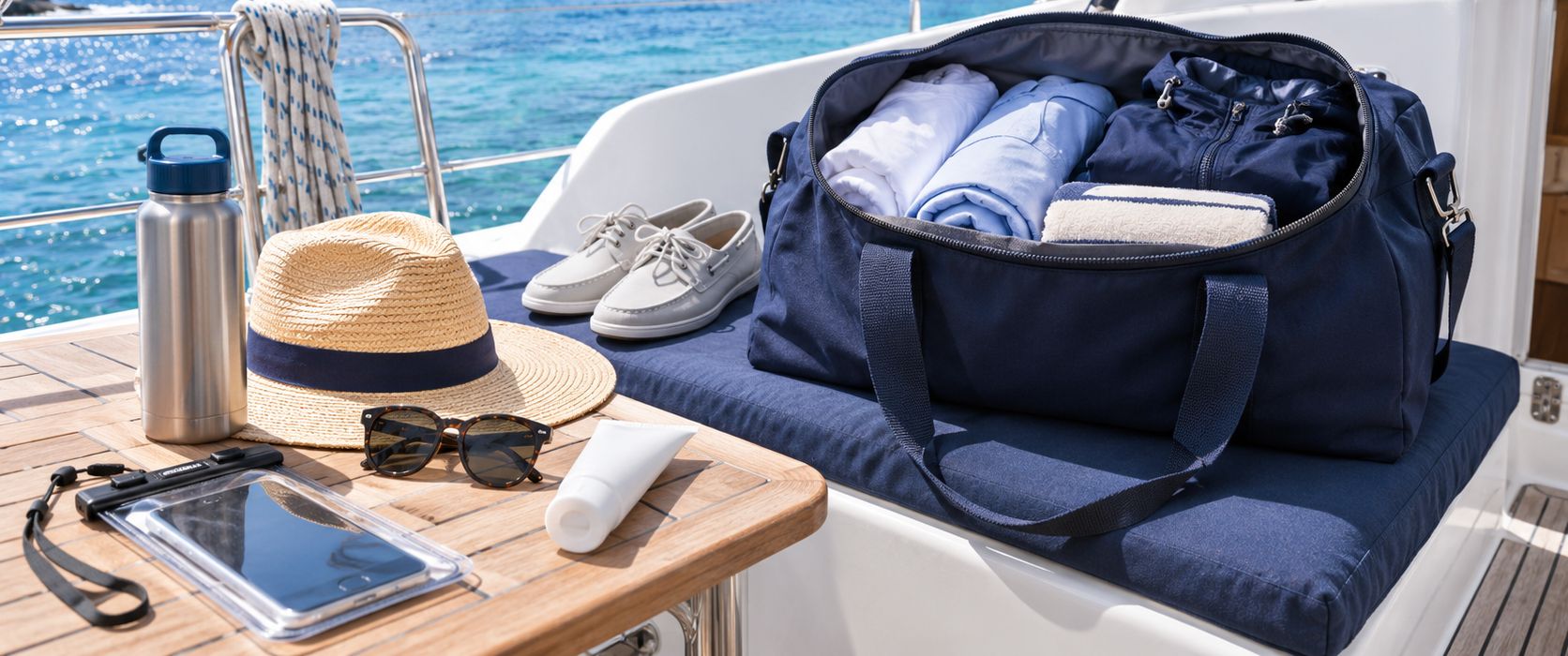
Footwear. Soft pump shoes. You should not wear black–soled footwear on-board the yacht. They leave marks that are hard to clean. Wear light-soled shoes instead. If it is possible, wear specialised yachting shoes. The best thing about them is that their soles do not slip on wet surfaces, especially when the yacht is staggering. Most other types of shoes leave marks on the deck and slip, which puts you at unnecessary risk.
Bring comfortable shoes for walking ashore.
A waterproof coat/jumper, trousers, or a jumpsuit. A waterproof yachting suit for colder weather. For warner countries, a light water-proof jumper will be enough. A good water- and wind-proof coat will save an amateur from rain and splash. Specialised yachting clothes are called oil skins. Such clothes are manufactured by Gill, Musto, etc.
Take warm clothes and some spare shoes along. After sunset the air temperature at the sea can go down significantly, and in the daytime it can get quite windy – we suggest that you take a sweater and a hat with you, even in summer. If you are going to visit a cold country, take several sweaters and warm trousers.
HANDS are the most important part of your body when on-board a yacht. Take care of them.
Yachting gloves. Those of you who are going to handle sails should wear them. The best option is gloves with open index finger and thumb. However, you can wear any other type of durable gloves.
Panama hat/baseball cap. We recommend that you wear a hat/cap with a strap that will prevent your headwear from being blown away be the wind.
Sunglasses. They should also have a strap.
A long-sleeved T-shirt that will save you from being sunburnt.
Socks. Experience has shown that the sock pair/days at the sea ratio should be 2/1. They are not a thing to save allowed weight on – your fellow yachtsmen will appreciate that! Take several pairs of socks per each day of your voyage!
Other necessary pieces of clothes on-board a yacht: T-shirts, undershirts, shorts, swimming trunks, swimming suits, etc. Keep clothes for yachting and walking ashore separately.
MEDICINES. Please, don’t forget to bring medicines that you may need with you. Your personal first-aid kit should include: bandages, burn/cut ointments, iodine, seasickness tablets – Dramina or Stugeron.
MISCELLANEOUS.
A water-proof document wallet/bag.
Personal hygiene items (do not bother buying soap, toilet paper etc. beforehand. You can buy them in situ). Take along a towel, a toothbrush, toothpaste, shampoo, etc.
You will be provided with bed linen. However, as practice has shown, there can never be too many towels.
Sunscreen (20-30 SPF).
Sport sunglasses (dark).
Your favourite CDs or music files on your iPod.
Flippers, a diving mask. As a rule, a yacht has 1-2 extra sets, but it is better to be on the safe side.
A guitar or any other musical instrument you can play – be it a saxophone, a flute, a bugle, or even a drum!
A mobile phone and its charger.
A photo camera (laptop) and its charger.
A 12-V charger for a mobile phone (vehicle-type).
A flashlight (it can be very useful on-board a yacht in the night).
Electric adapters.
Cash. ATMs are usually located far from the haven. It is not the wisest thing to waste time trying to find one.
Earmuffs. It can get noisy at sea. Moreover, some people snore!
A corkscrew.
A bag that you can fold and put on a shelf.
You should NOT take along:
- life vests (each yacht has them, one per each member of the crew);
- dishes and other kitchen accessories;
- plastic bags or hard cases – there can simply be not enough room for them.
- high-heeled shoes – you won’t be able to wear them.
- evening dresses – yachtsmen (and women) wear loose clothes.